
April, 2026
By Howie Goldfinger, CEO, Ecorite
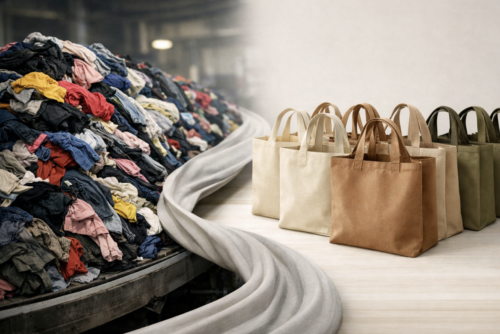
From waste stream to shelf-ready: the quiet transformation reshaping recycled-textile supply.
In a city most North American buyers have never heard of, a quiet shift in the recycled-textile supply chain is underway — and it touches the products we make.
Zhangjiagang, on China’s east coast, is now home to a recycling facility where an AI system called Fastsort-Textile scans used clothes by fibre composition and routes them — in under a second per garment — into nylon, polyester, and other sorting streams. One worker can push 100 kilograms through the line in two to three minutes. Doing the same by hand takes about four hours. Time magazine named it one of the Best Inventions of 2025.
The scale of the problem it’s chasing is larger than most people realize. About 70% of global textile production ends up in fashion, according to the non-profit Circle Economy. China alone exports US$142 billion in textiles annually — more than double the entire European Union — per the World Trade Organization’s 2025 report. And most blended garments never get recycled, because accurately identifying what’s in them has, until now, been slow, manual work.
Why the Sorting Problem Is the Real Problem
This is where it connects to our world. Recycled polyester — the RPET in many of the bags, coolers, and totes Ecorite has offered for years — has historically come from plastic bottles, because textile-to-textile recycling has been too expensive and too inaccurate to compete. The bottleneck was never the shredders or the extruders. It was the sorting.
If AI sorting at 80–90%+ accuracy scales across Chinese recycling hubs — and Zhangjiagang is a working facility, not a pilot — the supply of genuinely recycled polyester textile feedstock starts to grow.
That changes the math on circular promo products over the next several years. Recycled content stops being a nice story printed on a hang tag and becomes a larger, steadier, more auditable stream. For a supplier network like ours — sourcing mainly from China, India, and Bangladesh — upstream infrastructure improvements aren’t abstract. They’re upstream of everything we sell.
What This Means for Ecorite
Ecorite has been building around recycled, organic, and biodegradable materials since 1991. Roughly 70% of our stock carries an environmental benefit today — whether that’s RPET from recycled bottles, GOTS-certified organic cotton, or our Made-in-Canada cut-and-sew line.
A stronger upstream recycling industry — smarter, faster, and less dependent on landfill and incineration as the default — is exactly what makes that commitment easier to scale for the buyers and distributors we serve. When the sorting step works at industrial speed and industrial accuracy, the whole circle tightens. More fibre stays in use. Less ends up burned. And the “recycled” claim on a tote bag gets closer to what customers have always hoped it meant.
Good news, in other words. And about time.